Why Innovation Is Now a Core Leadership Competency
The future won't be led by the loudest voice in the room, but by the most curious.

Keith Laplante
Thirty-five years leading inside organizations (TD Waterhouse, BMO, HomeEquity Bank) and advising alongside them (Accenture, ExperiencePoint, The Refinery Leadership Partners). Facilitated leadership programs at Harvard, Duke, and Stanford. Read more about Keith
"The future doesn't need more command-and-control, it needs more courage and creativity."
August 19, 2025
The future won't be led by the loudest voice in the room, but by the most curious.
The most powerful question a leader can ask today isn't "What's the plan?"
It's "What if?"
In 2025, the landscape of leadership is being redrawn. With AI transforming how we work, global trade routes being renegotiated, and hybrid teams becoming the norm, the playbook for how to lead is shifting. What's needed now isn't just operational excellence or domain expertise. It's imagination, adaptability and innovation — and increasingly, the research backs this up: organizations that prioritize innovation at the leadership level grow faster, adapt quicker, and retain talent more effectively.
The Innovation-Leadership Gap
Here's the disconnect: while 84% of executives say innovation is important to their growth strategy, only 6% are satisfied with the outcomes of their innovation efforts (Harvard Business Review). Why? Because innovation is still too often treated as a department, a sprint, or a side project — not as a leadership mindset.
But when leaders themselves model curiosity, experiment openly, and build cultures where learning is celebrated — not punished — innovation stops being a buzzword. It becomes the way work gets done.
What Innovative Leaders Do Differently
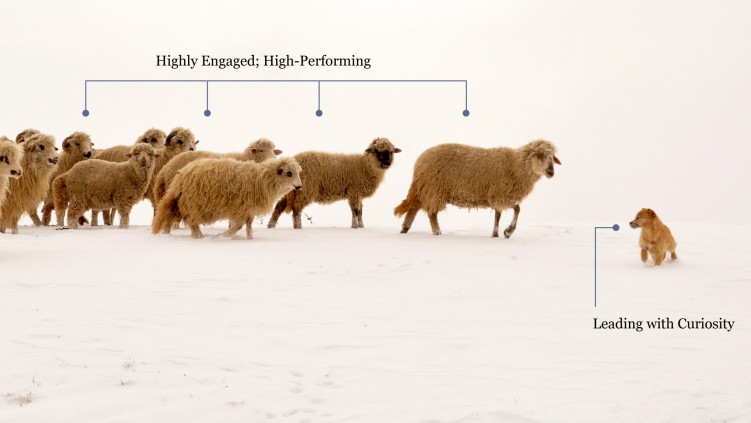
1. They Lead with Curiosity, Not Just Certainty
In a fast-moving world, knowing how to ask the right questions is often more valuable than having all the answers. Creating a "psychologically safe" environment where leaders actively encourage questioning and experimentation improves productivity by 12% and reduces turnover by 27% according to recent Gallup research.
2. They Empower, They Don't (Necessarily) Control
The most future-ready leaders understand that great ideas can come from anywhere, not just the C-suite. That's why they create conditions where teams feel safe to test ideas, speak up, and share bold suggestions. The impact here cannot be overstated. Quantum Workplace Research shows that 92% of executives say companies with high employee engagement have "happy customers" and 81% say highly engaged employees perform better.
3. They Turn Change Into a Catalyst
Whether it's navigating new AI capabilities, managing geopolitical risk, or reimagining customer experience, innovative leaders see disruption as fuel, not friction. They're not waiting for a return to stability; they're building stability by embracing change.
Innovation Is a Leadership Muscle You Can Strengthen
The good news? Innovation isn't about being a visionary genius. It's about practicing a set of learnable behaviors like active listening, inclusive collaboration, and structured experimentation. Progressive organizations are already investing in these skills. According to Deloitte's 2025 Human Capital Trends Report, 74% of high-performing companies are training leaders specifically in creativity, systems thinking, and agile decision-making. These aren't just "soft" skills — they're survival skills in a nonlinear world.
A New Model for What Resilience Looks Like
In the past, strong leadership was synonymous with control. Today, it looks more like trust, openness, and experimentation. Strong leaders admit what they don't know. They invite others into the process and they create space for smart risks because they know the real risk is standing still.
Leadership in this decade isn't just about driving performance; it's about shaping possibilities. It's about helping people feel confident, not because the future is clear, but because they know they can navigate it together.
The Future Is Already Here. Let's Lead Like It!
The challenges ahead are real, but so is the opportunity. Innovation isn't a "nice to have" for leaders anymore; it's a differentiator.
The leaders who will define the next decade won't be those who wait for the right moment to innovate. They'll be the ones who build momentum by making innovation a daily habit grounded in empathy, powered by collaboration, and driven by a belief that what's next can be better than what's now.
The future doesn't need more command-and-control, it needs more courage and creativity.